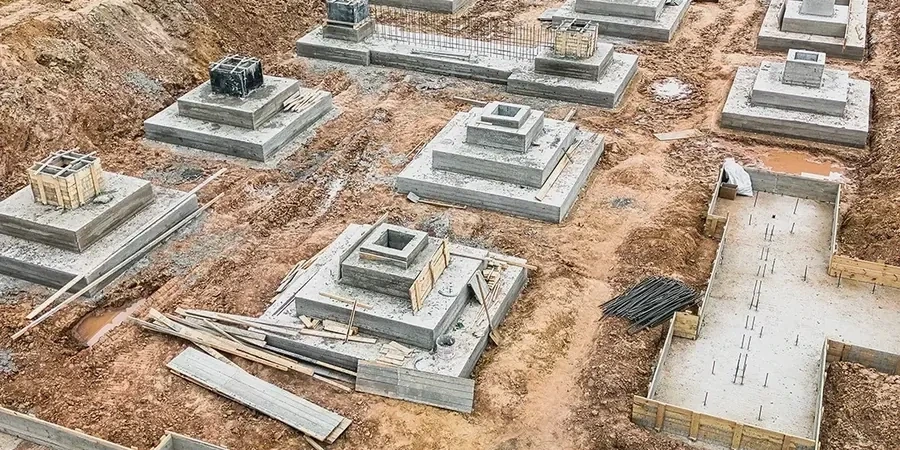
Foundation engineering in Brisbane represents a critical discipline within geotechnical practice, addressing the complex interaction between structural loads and the region's notoriously variable ground conditions. This category encompasses the full spectrum of subsurface investigation, bearing capacity assessment, settlement prediction, and foundation system design required to ensure safe, serviceable structures across South East Queensland. From high-rise developments in the CBD to residential subdivisions on the urban fringe, the adequacy of foundation design directly governs structural integrity, long-term performance, and compliance with regulatory requirements. Brisbane's unique geological setting, characterised by reactive clay soils, residual profiles derived from metamorphic and sedimentary rocks, and pockets of collapsible or soft alluvial deposits, demands a sophisticated, site-specific approach to foundation engineering. Professionals operating in this space must integrate detailed site characterisation with advanced analytical methods to mitigate risks associated with ground movement, differential settlement, and degradation over the design life of the asset.
The geological framework of Brisbane is dominated by the Neranleigh-Fernvale Beds, Brisbane Tuff, and extensive Quaternary alluvium along the Brisbane River floodplain, creating a mosaic of foundation conditions that vary dramatically over short distances. Residual clay soils derived from phyllite and metasiltstone exhibit moderate to high reactivity, with characteristic shrink-swell behaviour that can impose significant distress on lightly loaded foundations. In elevated areas, near-surface rock may provide excellent bearing capacity but introduces challenges related to excavation, slope stability, and the potential for differential behaviour at rock-soil interfaces. The floodplain corridors, particularly along the Brisbane River and its tributaries, present deep sequences of soft, compressible clays and loose sands that are prone to consolidation settlement and liquefaction under seismic loading. Understanding this geological context is fundamental to selecting appropriate foundation types, whether shallow footings on controlled fill, deep pile systems socketed into competent rock, or ground improvement techniques that modify the engineering properties of problematic soils. Comprehensive site investigation, including borehole drilling, cone penetration testing, and laboratory characterisation of soil index and strength properties, forms the essential precursor to any foundation design process.
Foundation design in Brisbane is governed by Australian Standards, principally AS 2159-2009 for piling design and installation, AS 2870-2011 for residential slabs and footings, and AS 4678-2002 for earth retaining structures, all operating within the broader framework of the National Construction Code. AS 2159 establishes rigorous requirements for geotechnical site investigation, pile load testing, and design methodologies that account for both ultimate limit state and serviceability limit state criteria, with specific provisions for the assessment of shaft adhesion and end bearing components in rock and soil. AS 2870 provides prescriptive guidance for footing systems on reactive clay sites, classifying sites based on characteristic surface movement and specifying standard designs for waffle raft, stiffened raft, and pier-and-beam configurations. Queensland-specific variations, including the Queensland Development Code and local government planning schemes, may impose additional requirements related to flood immunity, acid sulfate soil management, and erosion control. Compliance with these standards is not merely a matter of regulatory adherence but a fundamental component of professional practice that ensures foundation systems perform adequately under Brisbane's climatic conditions, including prolonged wet-dry cycles that exacerbate soil reactivity and extreme rainfall events that challenge drainage and subsurface stability.
The types of projects requiring comprehensive foundation engineering services in Brisbane span the full breadth of the built environment, from landmark commercial towers and infrastructure assets to detached dwellings and light industrial facilities. High-rise structures in the inner city typically demand deep foundation solutions, with pile foundation design incorporating large-diameter bored piles or driven piles that transfer loads to competent rock at depth, often requiring detailed assessment of pile skin friction vs. end bearing analysis to optimise pile geometry and penetration. Residential developments on reactive clay sites rely heavily on the principles of AS 2870, with expansive soil evaluation informing the selection of stiffened raft or pier-and-beam footing systems that accommodate ground movement without distress. Infrastructure projects, including bridges, retaining walls, and water treatment facilities, encounter deep alluvial deposits where settlement analysis becomes critical to predicting consolidation behaviour and ensuring long-term serviceability. In areas underlain by loess-derived silts or poorly compacted fill, collapsible soil evaluation is essential to identify potential for sudden volume reduction upon wetting, a phenomenon that can lead to catastrophic differential settlement if not addressed through ground treatment or deep foundation alternatives. Each project type demands a tailored approach that balances technical rigour with practical constructability and cost-effectiveness.
Brisbane's primary foundation challenges stem from widespread reactive clay soils that shrink and swell with moisture changes, deep alluvial deposits along river floodplains prone to consolidation settlement, and variable rockhead depths across the metamorphic terrain. These conditions necessitate thorough site investigation to classify soil reactivity in accordance with AS 2870, assess compressibility for settlement prediction, and determine pile socket requirements where shallow bearing is inadequate. Design responses range from moisture-controlled stiffened rafts on reactive sites to driven or bored piles founded in rock for heavier structures, always balancing geotechnical performance with construction practicality and long-term durability.
AS 2870-2011 governs the design of residential slabs and footings on expansive clay sites, classifying sites based on characteristic surface movement (ys) derived from soil reactivity, suction change, and depth of influence. Brisbane sites typically fall into Class M, H1, or H2 categories reflecting moderate to highly reactive clay profiles, with extreme Class E sites encountered in areas of deep, highly plastic basaltic clays. The standard prescribes deemed-to-comply footing systems for each class, including stiffened rafts with internal beams and pier-and-beam configurations, requiring geotechnical investigation to quantify soil properties and provide design parameters such as stiffness modulus and mound movement indices.
Pile load testing serves as the primary means of verifying design assumptions and confirming pile capacity, integrity, and load-displacement behaviour under axial and lateral loading. AS 2159-2009 mandates specific testing frequencies based on design complexity and risk, typically requiring static load tests on preliminary piles where design is not based on local experience, and routine dynamic testing or integrity assessment on production piles. In Brisbane, where pile performance depends critically on rock socket roughness, shaft adhesion in residual soils, and construction technique, load testing provides essential validation of design parameters and installation methods, reducing uncertainty and enabling optimisation of pile length and diameter.
Collapsible soils undergo sudden volume reduction upon wetting under load, causing severe differential settlement that can damage structures founded on shallow footings. In Brisbane, collapsible behaviour is associated with loess-derived silts, poorly compacted fill, and certain residual profiles with open, metastable fabric. Identification relies on in-situ testing including cone penetration tests that reveal low density at depth, combined with laboratory oedometer tests measuring collapse potential under inundation at service stress levels. Where collapsible soils are confirmed, foundation options include removal and recompaction, deep dynamic compaction, or bypassing the problematic layer with piles socketed into stable material.